
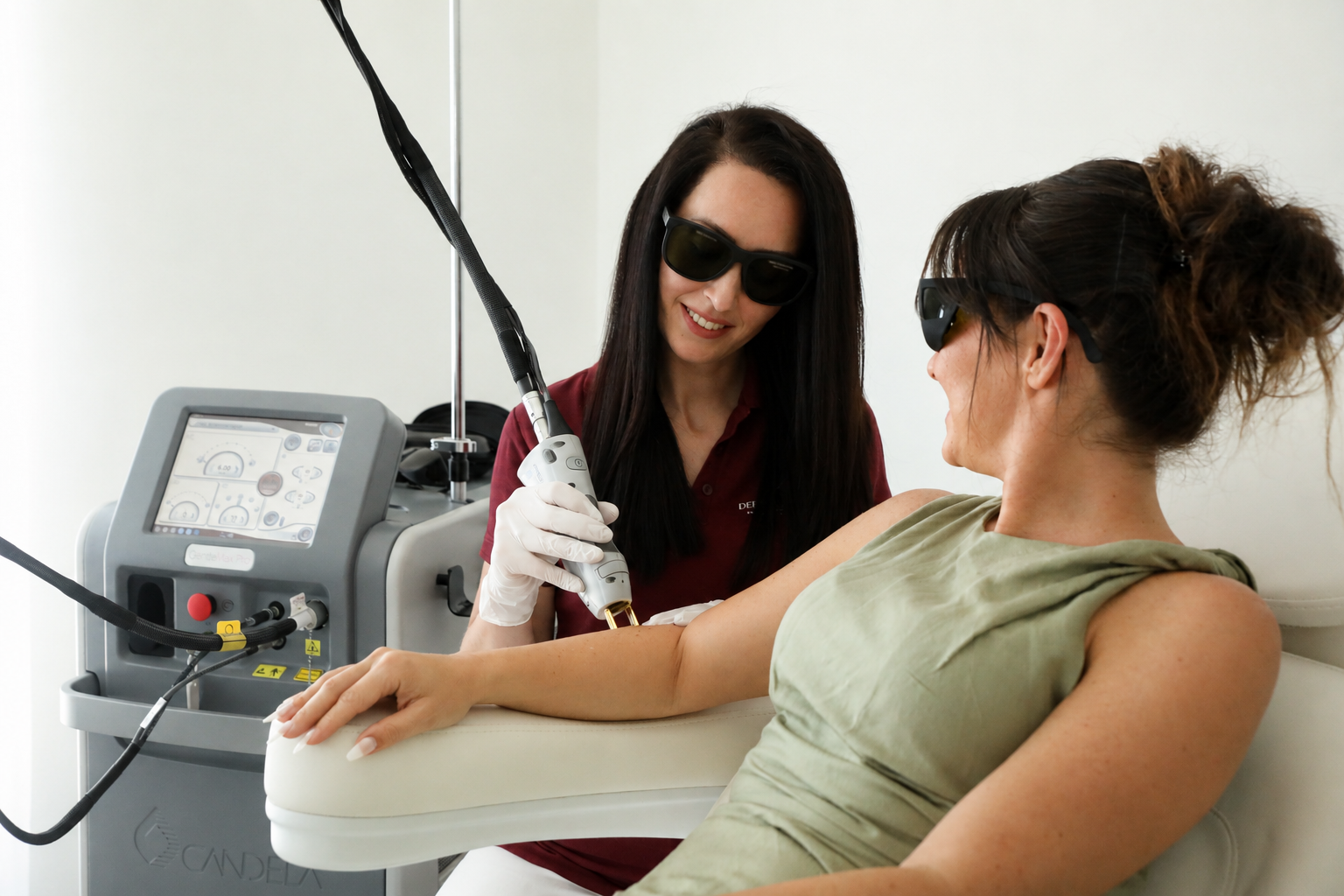
If you want to prevent ingrown hairs, you probably know the cycle inside out. Shaving, a few calm days, then the small red, sometimes painful bumps. You treat them, the skin settles down, and with the next shave it all starts over again.
Most advice online is about how to treat the bumps once they are already there. That is pure symptom management. The more interesting question is how to keep them from forming in the first place. And this is exactly where laser hair removal becomes interesting.
Why hairs grow in at all
To be able to prevent ingrown hairs, it helps to understand how they form in the first place. An ingrown hair develops when a hair does not grow straight through the skin surface but curves sideways or back into the skin. The body reacts to it as it would to a foreign object, with inflammation. The result is the typical bump, often reddened, sometimes with pus, occasionally painful.
The most common cause is the way we remove hair. When shaving, the hair is cut at an angle and therefore has a sharp tip. As it grows back, this tip can more easily pierce the wall of the skin instead of passing cleanly through. Waxing and plucking do pull the hair out at the root, but they also irritate the skin and disturb clean regrowth.
Two factors increase the risk further. Coarse or curly hair naturally tends to curve back into the skin. And when dead skin cells block the follicle opening, the hair finds no straight way out. Anyone who knows these mechanisms also understands why ingrown hairs are best prevented where you address the cause rather than the surface.
Why creams and exfoliants only help so much
Exfoliants, moisturisers and anti-inflammatory creams have their place. They keep the skin surface clear and can calm acute bumps.
What they do not change, however, is the cause. As long as the hair grows back and you remove it with the same method, the mechanism that produces the ingrown hairs remains. You manage the problem instead of resolving it. That is exactly why many people move within the same cycle for years.
In severe, chronic cases dermatology speaks of pseudofolliculitis barbae, so-called razor bumps. According to DermNet, this pattern occurs particularly often with coarse hair and in areas that are shaved regularly, such as the face, the underarms or the intimate area. DermNet explicitly names laser treatment as one of the effective options.
How laser tackles the problem at the root
The decisive difference lies in the point of action. Shaving, wax and creams work on the surface. Laser works on the follicle itself.
The light energy is absorbed by the melanin in the hair and converted into heat. This heat affects the structure responsible for regrowth. That a true laser works more precisely than a broadly scattering IPL device is something we explain in our comparison IPL vs laser hair removal.
When less and finer hair grows back in the treated area over time, the mechanical basis for ingrown hairs disappears as well. Less regrowing hair simply means fewer opportunities for a hair to curve back into the skin.
That is also the reason why we speak of a permanent reduction of hair growth and not of a promise of perfectly smooth skin forever. The direction is right, but only those who name the limits stay honest.
The point many providers keep quiet about
Here comes something that may irritate you at the beginning. In the first weeks after the first sessions, ingrown hairs can still appear, sometimes even new ones.
That is not a sign that the treatment is not working. After a session, the skin gradually sheds the treated hairs, and this process can temporarily look like an ingrown hair.
Only over several sessions does hair growth decrease overall, and with it the tendency to develop bumps. How many sessions are realistic for this is something we explain in the article how many laser hair removal sessions it takes. Anyone who has this course explained beforehand does not panic when it happens.
What you can contribute to the result yourself
Even though the laser addresses the cause, your behaviour supports the result. Between sessions you should only shave the treated area and not wax or epilate it, because plucking at the root disturbs the cycle the laser relies on.
Gentle exfoliation keeps the skin surface clear, and consistent sun protection protects the treated skin. These are small habits that make the difference between a good and a very good result.
Which zones this is particularly relevant for
Ingrown hairs occur most often where a lot of shaving is done regularly. In women these are above all the intimate area, the underarms and the legs, zones in which razor bumps and ingrown hairs are particularly annoying. What that means in concrete terms is something we discuss on our page about treatment for women.
In men it is classically the face and neck area, where razor bumps can become chronic, as well as the chest and back. Especially in the beard area the pattern is often stubborn, because the hair there is strong and frequently curved.
Preventing ingrown hairs with dermAesthetics in Ulm and Neu-Ulm
In short, creams treat the bump, permanent hair removal addresses its cause. If you really want to break the cycle of shaving, irritation and ingrown hairs, the way leads through less regrowing hair, not through the next tube.
That is exactly what dermAesthetics stands for. We look at your skin type and the affected zone individually and tell you honestly what is realistic in your case. For sensitive areas such as the intimate zone or the face we work particularly gently, because that is exactly where ingrown hairs are most bothersome.
Book your free initial consultation in Ulm and Neu-Ulm now. Twenty minutes are enough to find out whether laser is your way out of the cycle.